
Understanding Hyperlocal Advertising
What Is Hyperlocal Advertising?
In today’s competitive business landscape, reaching the right audience at the right time has become more important than ever. This is where hyperlocal advertising steps in as a powerful marketing strategy that focuses on targeting customers in a very specific geographic area—sometimes as small as a few streets, a neighborhood, or even a single block. Instead of broadcasting your marketing message to an entire city or region, hyperlocal advertising ensures that your message reaches people who are physically close to your business and most likely to become customers.
Imagine running a bakery and showing ads only to people who live within a one-mile radius of your shop. That’s hyperlocal advertising in action. This targeted approach significantly improves the chances of attracting customers who are ready to buy or visit your store. In fact, modern location-based marketing uses geographic data and mobile technologies to deliver ads exactly when consumers are nearby and actively searching for products or services.
The beauty of hyperlocal advertising lies in its precision. Rather than spending your entire marketing budget reaching thousands of uninterested users, businesses can focus on a small group of highly relevant customers. It’s like using a laser instead of a floodlight—sharp, focused, and incredibly effective. As digital platforms evolve, this strategy has become an essential tool for small and medium-sized businesses trying to dominate their local markets.
How Hyperlocal Advertising Works
Hyperlocal advertising operates through technologies such as GPS targeting, geo-fencing, and location-based data analysis. These tools allow businesses to deliver marketing messages to users based on their real-time location. For example, when someone walks near your store, they might see your ad on social media, Google, or mobile apps.
The process begins with defining a geographic boundary around your business. This boundary could be as small as 500 meters or as large as a few kilometers. Once the boundary is set, digital advertising platforms deliver ads only to users inside that area. Some advanced systems even analyze past locations and consumer behavior to predict where potential customers might go next.
Another key component is geo-targeting, which ensures that ads appear only to users in specific locations. Businesses can tailor their messaging according to local culture, events, or customer preferences. For instance, a restaurant might promote lunch specials during office hours to nearby professionals, while a gym could advertise evening discounts to residents in surrounding apartments.
The result? Highly personalized marketing that feels relevant and timely. When consumers see advertisements that match their immediate needs and location, they’re far more likely to engage with the brand. This is one of the main reasons hyperlocal advertising consistently delivers higher engagement and conversion rates compared to traditional marketing strategies.
Why Hyperlocal Advertising Matters for Local Businesses
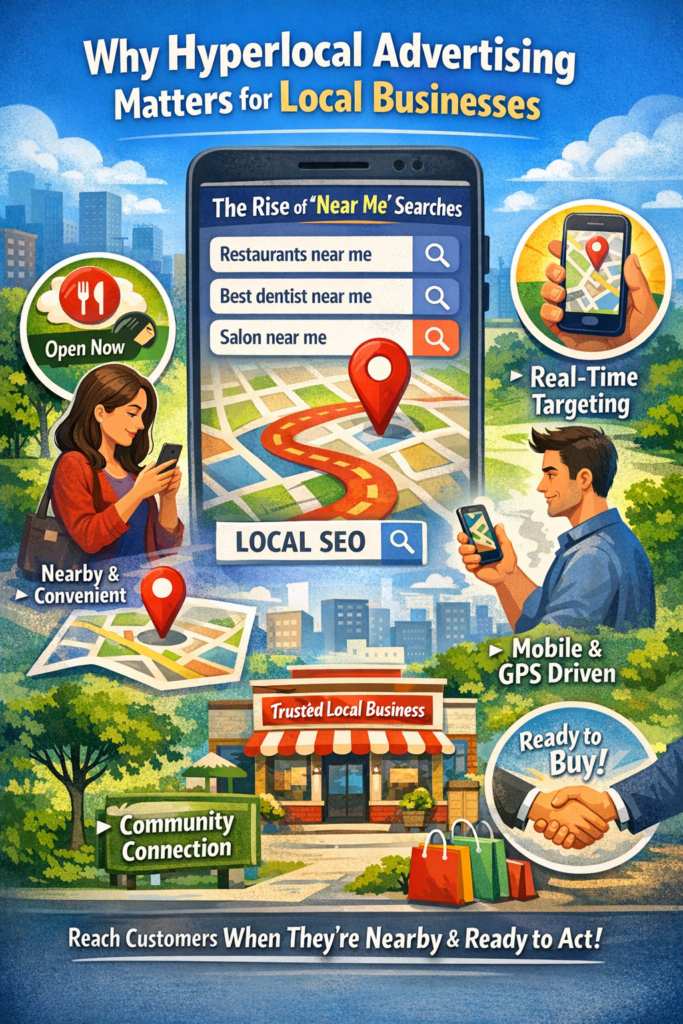
The Rise of “Near Me” Searches
Take a moment to think about your own search habits. How often do you type phrases like “restaurants near me,” “best dentist near me,” or “salon near me” into Google? Chances are, you’ve done it recently. This trend has exploded in recent years, and it’s fundamentally changing the way consumers discover businesses.
Hyperlocal advertising aligns perfectly with this behavior. Instead of hoping customers stumble upon your business, you position your brand exactly where they’re looking. Search engines and digital platforms prioritize nearby results when users perform location-based searches, giving local businesses a massive opportunity to capture attention.
Studies show that consumers increasingly prefer nearby services that are convenient and accessible. People want quick solutions, minimal travel time, and businesses they can trust within their communities. Hyperlocal advertising taps directly into this demand by connecting businesses with customers who are already nearby and ready to make a purchase.
Changing Consumer Behavior in Local Markets
Consumer behavior has shifted dramatically in the digital age. People are no longer willing to travel long distances for everyday services unless absolutely necessary. Instead, they prefer businesses that are close to home and easy to reach. This shift has made local visibility more important than ever.
Another major factor is the rise of smartphones. Mobile devices have become the primary gateway to the internet for millions of consumers. With GPS-enabled smartphones, marketers can identify exactly where users are and serve relevant ads in real time. This creates opportunities for businesses to interact with potential customers at the exact moment they’re searching for products or services.
Local trust also plays a huge role. Customers tend to trust businesses that appear active within their community. When people see advertisements referencing their neighborhood or local landmarks, it instantly feels more authentic and relatable. Hyperlocal advertising uses this psychological advantage to build stronger connections between brands and their audiences.
Key Benefits of Hyperlocal Advertising
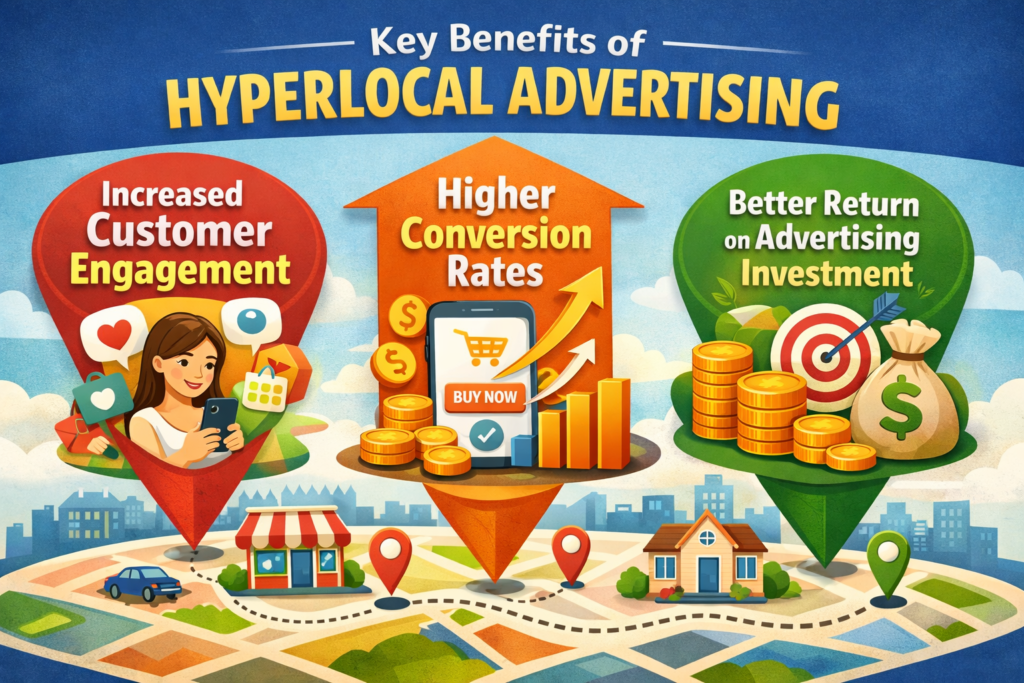
Increased Customer Engagement
One of the biggest advantages of hyperlocal advertising is the ability to create highly personalized experiences for customers. When advertisements are tailored to a specific neighborhood or community, they naturally resonate more with the audience. People are far more likely to engage with marketing messages that feel relevant to their daily lives.
For example, imagine receiving a notification about a coffee discount while walking near a café on your morning commute. The timing and location make the offer irresistible. This level of relevance significantly increases engagement rates compared to generic advertisements that target broad audiences.
Businesses can also incorporate local culture and events into their campaigns. A clothing store might promote festival-themed outfits during local celebrations, while a restaurant might advertise special dishes during community events. These localized campaigns make customers feel seen and valued, strengthening their emotional connection with the brand.
Higher Conversion Rates
Hyperlocal advertising doesn’t just generate engagement—it drives real results. Because the ads reach people who are physically close to a business, the likelihood of conversion increases dramatically. These customers are already in the area, making it easier for them to visit the store or complete a purchase.
Location-based marketing has proven particularly effective at driving foot traffic to physical stores. When customers receive promotions while they’re nearby, the barrier between seeing the ad and visiting the business becomes incredibly small. This immediate accessibility is what makes hyperlocal campaigns so powerful.
Businesses also benefit from tracking capabilities that measure real-world results. Many advertising platforms can track store visits, purchases, and customer interactions generated by hyperlocal campaigns. This allows businesses to analyze performance and refine their strategies for even better results in the future.
Better Return on Advertising Investment
Traditional advertising often wastes a large portion of the budget on audiences that have little interest in the product. Hyperlocal advertising solves this problem by focusing only on relevant customers within a specific geographic area.
Because the targeting is so precise, businesses spend less money reaching uninterested users. Every marketing dollar goes toward attracting customers who are more likely to engage and convert. This efficiency leads to a significantly higher return on investment.
Hyperlocal advertising also allows businesses to test campaigns on a small scale before expanding them. If a particular ad performs well in one neighborhood, the strategy can be replicated in other areas. This approach minimizes risk and maximizes marketing effectiveness.
Popular Hyperlocal Advertising Channels
Google Local Ads
Google is one of the most powerful platforms for hyperlocal advertising. Businesses can appear in search results when users look for nearby services, ensuring maximum visibility at the moment of intent. Google’s location-based features allow advertisers to target specific cities, neighborhoods, or even street-level locations.
These ads often appear in Google Maps and local search results, making them extremely effective for driving foot traffic. When customers search for nearby businesses, Google displays relevant options along with directions, reviews, and contact information. This seamless experience encourages users to visit the business immediately.
Social Media Geotargeted Ads
Social media platforms such as Facebook and Instagram offer advanced location-targeting capabilities. Businesses can create ads that appear only to users within a specific radius of their location. This allows brands to connect with local audiences who are most likely to become loyal customers.
Geotargeted ads can also incorporate local hashtags, neighborhood references, and community trends. This makes the content feel more authentic and relatable. Many businesses combine hyperlocal ads with engaging visuals, promotions, and customer testimonials to build trust within the community.
Mobile Push Notifications
Mobile push notifications represent one of the most direct forms of hyperlocal marketing. Businesses can send instant messages to users’ smartphones when they enter a specific geographic area. This technique is commonly used by retail stores, restaurants, and shopping malls.
For example, a clothing store might send a notification offering a limited-time discount to shoppers walking nearby. The urgency and convenience of these messages often lead to immediate action. Because the notification reaches users in real time, the chances of conversion are significantly higher.
Hyperlocal Advertising Strategies That Work
Local SEO Optimization
Local search engine optimization (SEO) is the backbone of hyperlocal advertising. By optimizing your website and online listings for local keywords, you increase your chances of appearing in nearby searches. This includes phrases such as “best pizza in my city” or “salon near me.”
Businesses should also ensure that their Google Business Profile is fully optimized with accurate information, photos, and customer reviews. Positive reviews play a crucial role in building trust and attracting new customers. When potential customers see strong ratings and authentic feedback, they’re more likely to choose that business over competitors.
Geo-Targeted Paid Ads
Paid advertising becomes far more powerful when combined with geographic targeting. Platforms like Google Ads and Facebook Ads allow businesses to display ads only to users within a defined radius. This ensures that marketing efforts focus exclusively on potential customers in the immediate area.
Businesses can experiment with different ad formats, including display ads, search ads, and video ads. Testing multiple variations helps identify which messages resonate most with the local audience. Over time, this data-driven approach leads to highly optimized campaigns that deliver consistent results.
Local Influencer Collaborations
Local influencers can amplify hyperlocal marketing efforts by introducing businesses to their established audiences. These influencers often have strong relationships with their followers and can recommend products or services in an authentic way.
For instance, a restaurant might partner with a local food blogger to showcase its menu and ambiance. When followers see someone they trust enjoying the experience, they’re more likely to visit the restaurant themselves. This word-of-mouth effect can significantly boost brand visibility and credibility within the community.
Real Examples of Hyperlocal Advertising Success
Local Café Marketing Example
Consider a small café located in a busy urban neighborhood. Instead of advertising across the entire city, the café focuses on customers within a two-kilometer radius. They run Instagram ads targeting local office workers and residents, promoting a breakfast combo for commuters.
At the same time, they optimize their Google listing for local searches like “coffee near me” and encourage satisfied customers to leave reviews. The café also collaborates with a local lifestyle influencer who posts about their cozy atmosphere and signature drinks.
Within a few months, the café sees a noticeable increase in foot traffic and repeat customers. The hyperlocal strategy works because it focuses on people who are already nearby and likely to visit regularly. This example illustrates how small businesses can achieve big results by targeting their immediate communities.
Tools and Technologies for Hyperlocal Marketing
The success of hyperlocal advertising relies heavily on modern marketing technologies. Tools such as Google Ads, Facebook Ads Manager, and location analytics platforms allow businesses to create precise campaigns and measure results effectively.
Advanced tools also provide insights into customer behavior, including store visits, engagement rates, and conversion data. These insights help businesses understand what works and what doesn’t, enabling them to refine their strategies over time.
Artificial intelligence is also playing an increasingly important role. AI-powered marketing platforms analyze large volumes of data to identify patterns and predict consumer behavior. This allows businesses to deliver highly personalized advertisements at the perfect moment.
Challenges of Hyperlocal Advertising
Despite its many advantages, hyperlocal advertising is not without challenges. One of the biggest difficulties is maintaining accurate location data. If targeting parameters are not set correctly, businesses might miss potential customers or reach the wrong audience.
Another challenge involves creating relevant content for different neighborhoods or communities. What works in one area may not resonate in another. Businesses must invest time in understanding local preferences, culture, and consumer behavior to craft effective campaigns.
Budget allocation can also be tricky. While hyperlocal advertising is generally cost-effective, businesses still need to experiment with different strategies to find the most profitable approach. Continuous monitoring and optimization are essential for long-term success.
Future Trends in Hyperlocal Marketing
The future of hyperlocal advertising looks incredibly promising. As technologies such as artificial intelligence, augmented reality, and advanced data analytics continue to evolve, businesses will gain even more precise targeting capabilities.
Voice search is also expected to play a major role in local marketing. As more people use voice assistants to search for nearby services, businesses will need to optimize their content for conversational queries.
Another exciting trend is the integration of hyperlocal advertising with smart devices and connected environments. Imagine receiving personalized promotions while walking through a shopping district or attending a local event. These innovations will create new opportunities for businesses to engage with customers in meaningful ways.
Conclusion
Hyperlocal advertising has emerged as one of the most powerful strategies for businesses looking to dominate their local markets. By focusing on specific neighborhoods and communities, companies can deliver highly relevant marketing messages that resonate with nearby customers. This targeted approach increases engagement, boosts conversions, and maximizes the return on marketing investment.
In an era where consumers expect personalized experiences and instant solutions, hyperlocal advertising provides exactly what they want—relevant information at the right place and the right time. Businesses that embrace this strategy will not only attract more customers but also build stronger relationships within their communities.
The secret to growing your business in your city might not lie in reaching millions of people. Sometimes, success simply means reaching the right people who live just around the corner.