
The Modern Advertising Battlefield
Why Big Brands Traditionally Win
For decades, advertising has been a game dominated by deep pockets. Big brands had the luxury of spending millions on television ads, billboards, celebrity endorsements, and large-scale campaigns that flooded every possible channel. When you think about it, their advantage wasn’t just money—it was visibility. The more people saw their ads, the more familiar they became, and familiarity often leads to trust. However, with the rise of smart advertising, this traditional advantage is no longer as dominant as it once was.
Small businesses, on the other hand, struggled to even get noticed. Limited budgets meant limited reach, and limited reach meant fewer customers. Traditional advertising channels like TV and print were simply too expensive. It created an uneven playing field where small businesses were almost invisible next to corporate giants. But today, smart advertising strategies are helping small businesses overcome these challenges by focusing on precision targeting and cost-effective campaigns.
But here’s the twist—this dynamic is rapidly changing. The digital revolution has flipped the script. Today, visibility is no longer just about how much you spend; it’s about how smart you are with your strategy. Smart advertising leverages data, audience insights, and digital platforms to maximize impact without requiring massive budgets. This means even small businesses can compete effectively by making smarter decisions rather than bigger investments.
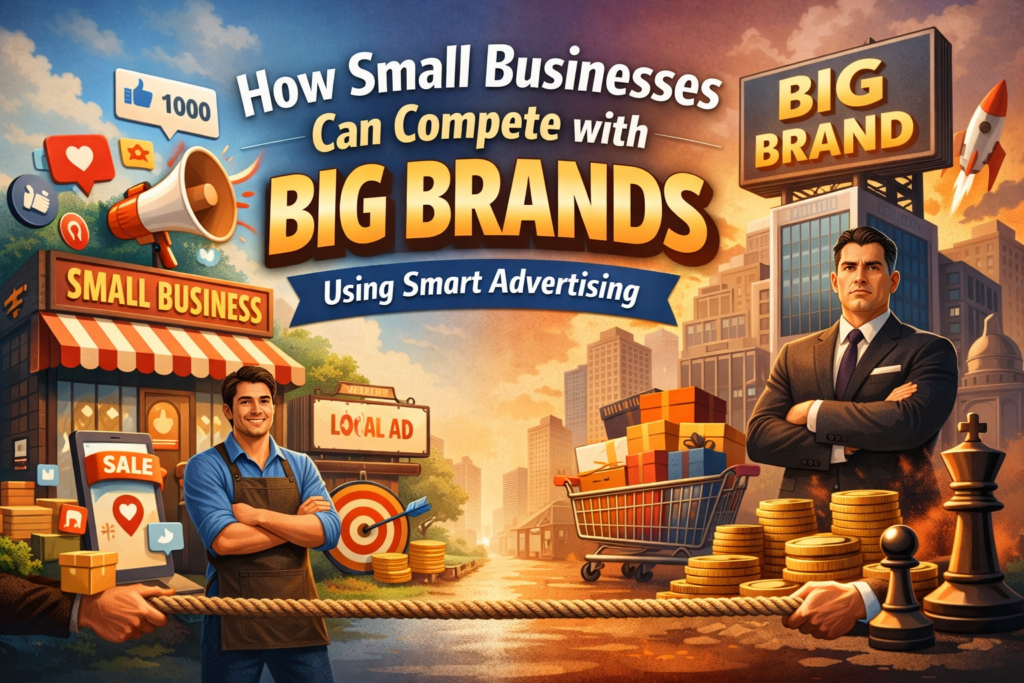
The Rise of Digital Equality
We are living in a time where digital advertising dominates the global market, accounting for nearly 69% of total ad spend worldwide . That’s not just a statistic—it’s a massive opportunity. Digital platforms like social media, search engines, and video platforms have become the new battleground where small businesses can compete head-to-head with big brands.
Even more interesting is how discovery has changed. Around 58% of consumers now discover new businesses through social media . This means a small business with a clever Instagram reel or a viral TikTok video can gain attention just as quickly as a multinational corporation.
The playing field is no longer about size—it’s about strategy. And that’s where smart advertising comes into play.
Understanding Smart Advertising
What Makes Advertising “Smart” Today
Smart advertising isn’t about spending more—it’s about spending better. It’s about using data, technology, and creativity to reach the right audience at the right time with the right message. Think of it like fishing: instead of casting a wide net and hoping for the best, you’re using a precise hook to catch exactly the fish you want.
Modern tools like AI, analytics, and automation allow businesses to understand customer behavior in ways that were unimaginable a decade ago. You can now track what your audience clicks, what they watch, and even how long they stay on your website.
Data-Driven vs Budget-Driven Marketing
In the past, marketing success was often tied to how much you could spend. Today, it’s about how well you use your data. Businesses that rely on data-driven decisions consistently outperform those relying on intuition .
Smart advertising uses insights like:
- Customer demographics
- Online behavior
- Purchase history
- Engagement patterns
This allows small businesses to create highly targeted campaigns that deliver better results with less money. It’s not about shouting louder—it’s about speaking directly to the right people.
Leveraging Digital Marketing Channels
Social Media as a Growth Engine
Social media is arguably the most powerful tool available to small businesses today. Platforms like Instagram, Facebook, and TikTok have turned ordinary businesses into viral sensations overnight. The best part? You don’t need a massive budget to succeed—you just need creativity and consistency.
Social media ads are also growing rapidly, with billions being spent annually and increasing year after year . This growth shows how effective these platforms have become for reaching audiences.
Choosing the Right Platforms
Not every platform is right for every business. A local bakery might thrive on Instagram with mouth-watering visuals, while a B2B service provider might find better results on LinkedIn. The key is understanding where your audience spends their time.
SEO and Content Marketing
Search engines drive a massive portion of online traffic—about 93% of all website traffic comes from search engines . That means if your business isn’t visible on Google, you’re missing out on a huge opportunity.
Content marketing, including blogs and videos, plays a critical role here. In fact, blog posts are among the top ROI-generating content formats . By creating valuable, informative content, small businesses can attract organic traffic and build authority in their niche.
The Power of Personalization
Using Customer Data Effectively
Imagine walking into a store where the salesperson already knows your preferences. That’s exactly what personalization does in advertising. It creates a tailored experience that makes customers feel understood and valued.
With modern tools, even small businesses can analyze customer data and create personalized campaigns. This could be as simple as sending targeted email offers or as advanced as dynamic website content that changes based on user behavior.
Hyper-Targeted Campaigns
Hyper-targeting allows businesses to focus on specific segments of their audience. Instead of targeting everyone, you target those most likely to convert. This increases efficiency and reduces wasted ad spend.
For example, a local gym can target ads specifically to people within a 5 km radius who are interested in fitness. This level of precision was impossible in traditional advertising.
Building Brand Authenticity
Why Authenticity Beats Budget
Here’s something big brands often struggle with: authenticity. While they may have massive budgets, they often lack the personal touch that small businesses naturally have.
Consumers today crave genuine connections. They want to support businesses that feel real and relatable. In fact, a significant number of consumers expect businesses to engage with their communities and support meaningful causes .
Storytelling in Advertising
Storytelling is one of the most powerful tools in advertising. Instead of just selling a product, you’re sharing a journey, a mission, or a purpose. This creates an emotional connection that goes beyond price or features.
Small businesses have an advantage here because their stories are often more personal and relatable. Whether it’s a family-run business or a startup with a unique vision, these stories resonate deeply with audiences.
Smart Use of AI and Automation
AI Tools for Small Businesses
Artificial Intelligence is no longer reserved for big corporations. Today, 67% of small businesses are already using AI tools for marketing . These tools can help with everything from content creation to customer service.
AI can analyze data, predict trends, and even generate ad copy. This allows small businesses to operate with the efficiency of much larger organizations.
Cost Efficiency and Scale
One of the biggest advantages of AI is cost efficiency. Tasks that once required entire teams can now be automated. This not only saves money but also allows businesses to scale their efforts without increasing their budget significantly.
Influencer and Community Marketing
Micro-Influencers vs Celebrities
Influencer marketing has exploded in recent years, with billions being spent globally. But here’s the interesting part—micro-influencers often outperform celebrities.
Why? Because they have more engaged audiences. Their followers trust them, and that trust translates into higher conversion rates. For small businesses, collaborating with micro-influencers is a cost-effective way to reach niche audiences.
Local Community Engagement
Small businesses have a unique advantage: they are part of the community. By engaging with local events, supporting local causes, and building relationships, they can create loyal customer bases that big brands struggle to replicate.
Multi-Channel Advertising Strategy
Combining Online and Offline Channels
Smart advertising isn’t limited to digital platforms. Combining online and offline strategies can create a powerful synergy. For example, a local business can use social media ads to drive traffic to an in-store event.
Consistent Brand Messaging
Consistency is key. Whether it’s a Facebook ad, a website, or a physical store, the message should be the same. This builds trust and reinforces brand identity.
Measuring and Optimizing Campaigns
Key Metrics to Track
To compete effectively, small businesses need to track performance. Some key metrics include:
- Conversion rate
- Click-through rate
- Customer acquisition cost
- Return on investment
Continuous Improvement
Advertising is not a one-time effort—it’s an ongoing process. By analyzing data and making adjustments, businesses can continuously improve their campaigns and achieve better results over time.
Conclusion
Competing with big brands is no longer about matching their budgets—it’s about outsmarting them. With the rise of digital platforms, data-driven strategies, and advanced tools like AI, small businesses now have everything they need to level the playing field.
The key lies in being strategic, authentic, and adaptable. By focusing on targeted advertising, personalization, and community engagement, small businesses can not only compete but thrive in today’s competitive market.